

Market Resilience in Uncertain Conditions: Chris on Fox Business
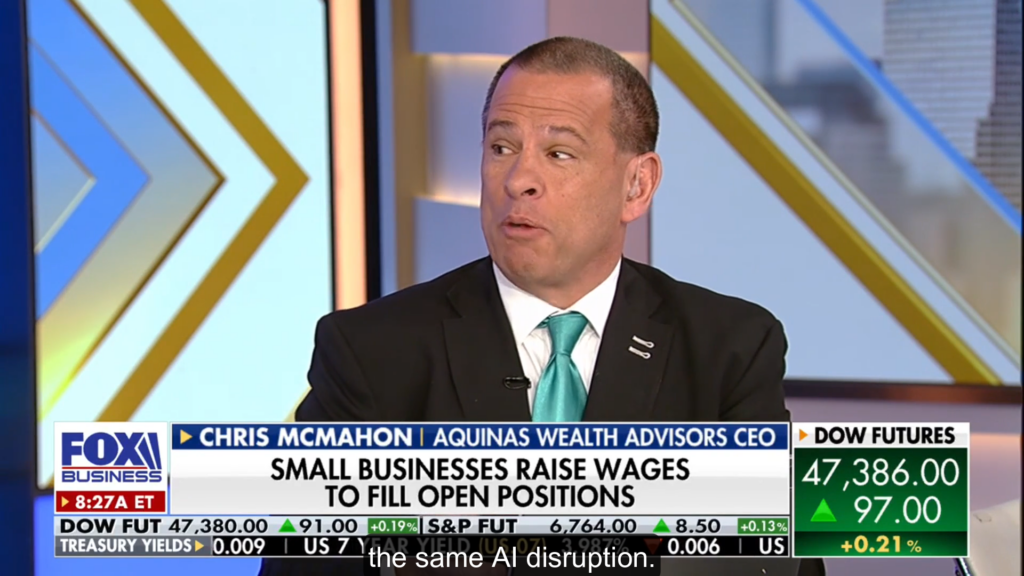
Chris McMahon on Fox Business – ‘Making Money with Charles Payne’
In a recent appearance on Fox Business’s Making Money with Charles Payne, Chris shared perspective on how markets are responding amid geopolitical developments and ongoing uncertainty. Rather than focusing on predictions, the conversation centered on how markets behave under pressure—and what that may signal about broader sentiment.
Key Takeaways
- Markets can demonstrate resilience even amid geopolitical disruptions
- Short-term reactions don’t always reflect underlying investor sentiment
- There can be a disconnect between Wall Street activity and Main Street perception
- Periods of uncertainty may still coincide with measured optimism
- Market behavior often reflects a range of inputs beyond headline events
Why This Matters for Investors
Moments of uncertainty often bring heightened attention to market movements. Understanding how markets respond—not just what they do—can provide helpful context for interpreting volatility.
Rather than reacting to individual headlines, observing broader patterns of resilience, sentiment, and participation can offer a more balanced perspective. This type of lens may help investors stay focused on long-term principles instead of short-term noise.
Frequently Asked Questions
Q: What does “market resilience” mean in this context?
Market resilience refers to the ability of financial markets to remain stable or even move higher despite negative news, uncertainty, or external shocks. In this context, it highlights how markets can absorb geopolitical developments or economic concerns without reacting as dramatically as expected. This doesn’t mean risks are absent—it simply reflects how markets process and weigh multiple inputs at once.
Q: Why might markets rise even during periods of geopolitical tension?
Market performance is influenced by a wide range of factors, including expectations about future conditions, economic data, corporate performance, and investor positioning. While geopolitical events can create uncertainty, markets may already have priced in certain risks or may be focusing on longer-term fundamentals. As a result, short-term market direction doesn’t always align directly with headline events.
Q: What is meant by a disconnect between Wall Street and Main Street?
A disconnect between Wall Street and Main Street refers to differences between market performance and the everyday economic experience of individuals and businesses. Financial markets often respond to forward-looking expectations, while households and businesses may be reacting to current conditions like inflation, employment, or cost of living. This gap can create the perception that markets and the real economy are moving in different directions.
Q: How should investors interpret short-term market reactions to news events?
Short-term market movements can reflect immediate reactions to new information, but they are often influenced by sentiment, positioning, and technical factors. Because of this, a single day’s movement may not provide a complete picture of underlying trends. Looking at broader patterns over time can offer more meaningful context than focusing on isolated reactions.
Q: Does market resilience mean risks are lower?
Not necessarily. Market resilience does not eliminate underlying risks or uncertainties. Instead, it reflects how markets are currently responding to those risks. Conditions can change, and resilience in one period does not guarantee similar behavior in the future. Maintaining awareness of both risks and long-term objectives remains important when evaluating market developments.
Transcript
Charles: Overall, how you feeling about this market? I mean, do you like the way it’s acting in the face of everything?
Chris: I think it shows the resilience of our market. You just went through it a few minutes ago. It’s an exciting time. They declared an embargo today, right? They shut off the Strait of Hormuz. The market was up 20 points. It shows that people are not—they’re setting aside Wall Street. Main Street feels differently. There’s optimism.
Charles: Mr. Chris, thank you, buddy. Appreciate it.
The views and opinions expressed in this video are those of the speaker as of the date of the original broadcast. These views are subject to change without notice.
Statements contained in this video that are forward-looking in nature are based on assumptions and expectations that may not materialize. Actual results and market conditions may differ materially from those expressed or implied. This video is provided for general informational purposes only and does not constitute investment advice, a recommendation, or an offer to buy or sell any security. Past performance is not indicative of future results.